Summary: Six Birmingham autism therapy options to shortlist in Alabama are Glenwood Behavioral Therapy Center, Mitchell’s Place, Hopebridge Avondale Autism Therapy Center, Behavioral ONE, The HANDS Program and Connected ABA Collaborative. Mitchell’s Place names ABA, speech and occupational therapy; Hopebridge Avondale offers clinic-based ABA. Confirm each provider’s age range, services, insurance, referral requirements and current availability.
Autism Therapy Centers in Alabama: 6 Birmingham Options
Compare six Birmingham autism therapy options by age served, named services and clinic setting, then use Alabama Medicaid checks to prepare for an intake call.
The intake coordinator says the next opening is for an autism intake, then asks whether your child needs ABA, speech therapy, occupational therapy or a referral. The question sounds simple until each provider website uses different wording, and the wrong call leaves a family repeating the search instead of moving toward care.
A search for aba therapy centers in Alabama should start with fit, not with a star rating or a claim that one center is best for every child. The defensible shortlist is the one where you can verify the city, age served, therapy setting, insurance network, referral rules and new-patient availability before you share records.
Six Alabama options below are centered on Birmingham because the supplied provider facts support those locations and services. The list is a starting shortlist, not clinical advice: public reviews and directory fields are useful signals, but they do not prove clinical outcomes or current openings, so each entry ends with the question to ask next.
1. Glenwood Behavioral Therapy Center: child and teen autism care
Glenwood Behavioral Therapy Center in Birmingham serves children and adolescents in Birmingham, including those with autism. Glenwood belongs on a family shortlist when the person needing care is a child or teenager and the first screening question is whether the center works with autism rather than adult behavioral health needs.
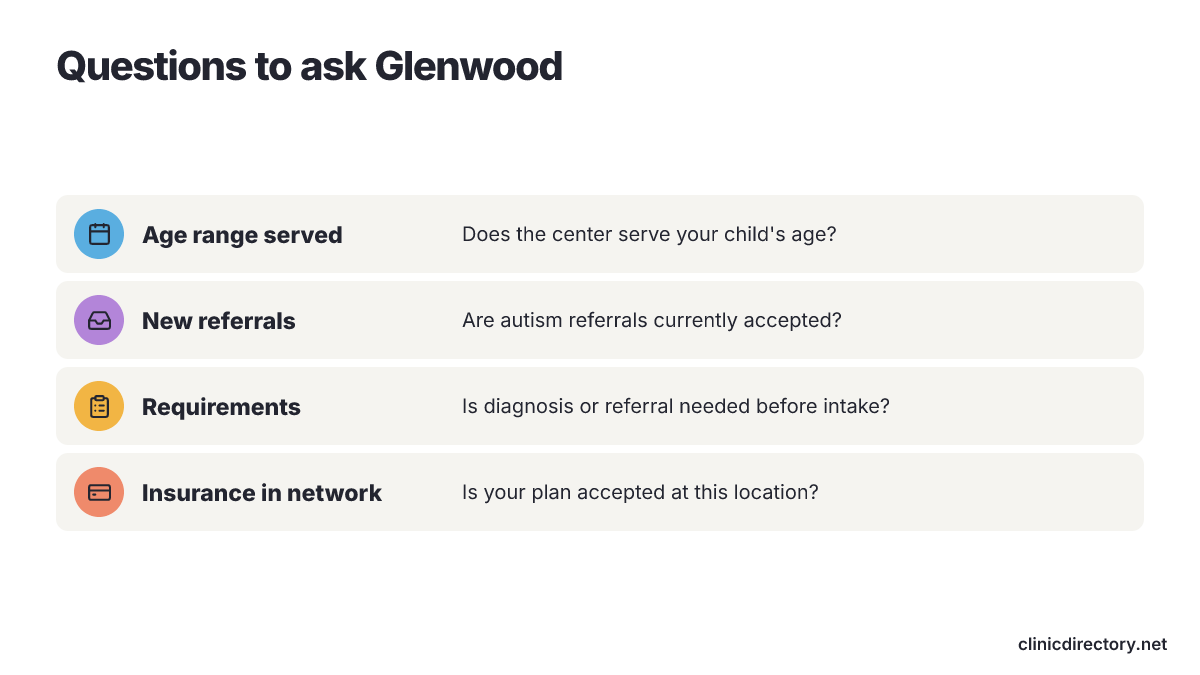
Glenwood is a sensible first call for a caregiver who wants a program explicitly tied to children and adolescents before asking about intake steps. The next question for Glenwood is narrow: ask whether the center is accepting new autism-related referrals for your child's age, whether a diagnosis or referral is required before intake, and which insurance plans are currently in network.
The age range is the clearest fit signal in Glenwood's supplied description, while the description does not name specific therapy types or a treatment setting. Ask the intake coordinator to identify the services available for your child before comparing Glenwood with a provider whose public description names ABA, speech or occupational therapy.
2. Mitchell's Place: ABA, speech and occupational therapy
Mitchell's Place in Birmingham offers ABA, speech and occupational therapy in Birmingham. Mitchell's Place is useful for a family trying to compare more than one therapy type in the same search, especially when a child's plan may involve communication, daily skills or behavior-related support.
Mitchell's Place is the strongest fit on this list when the search is not just for an aba therapy clinic but for a provider that names ABA alongside speech and occupational therapy. The call should focus on sequencing: ask whether the child needs separate evaluations for each service, whether therapy plans are coordinated across services, and whether each service has the same insurance and referral requirements.
Having three named services in one provider description makes Mitchell's Place a useful call when a caregiver is still clarifying which service to pursue. The listing alone does not establish whether a child can receive multiple services there, so ask whether each service has its own intake process and current availability.
3. Hopebridge Avondale Autism Therapy Center: clinic-based ABA
Hopebridge Avondale Autism Therapy Center offers clinic-based ABA therapy in Birmingham. Hopebridge Avondale fits families who already know ABA is the service they want to check and prefer a clinic setup instead of starting with broad behavioral health searches.
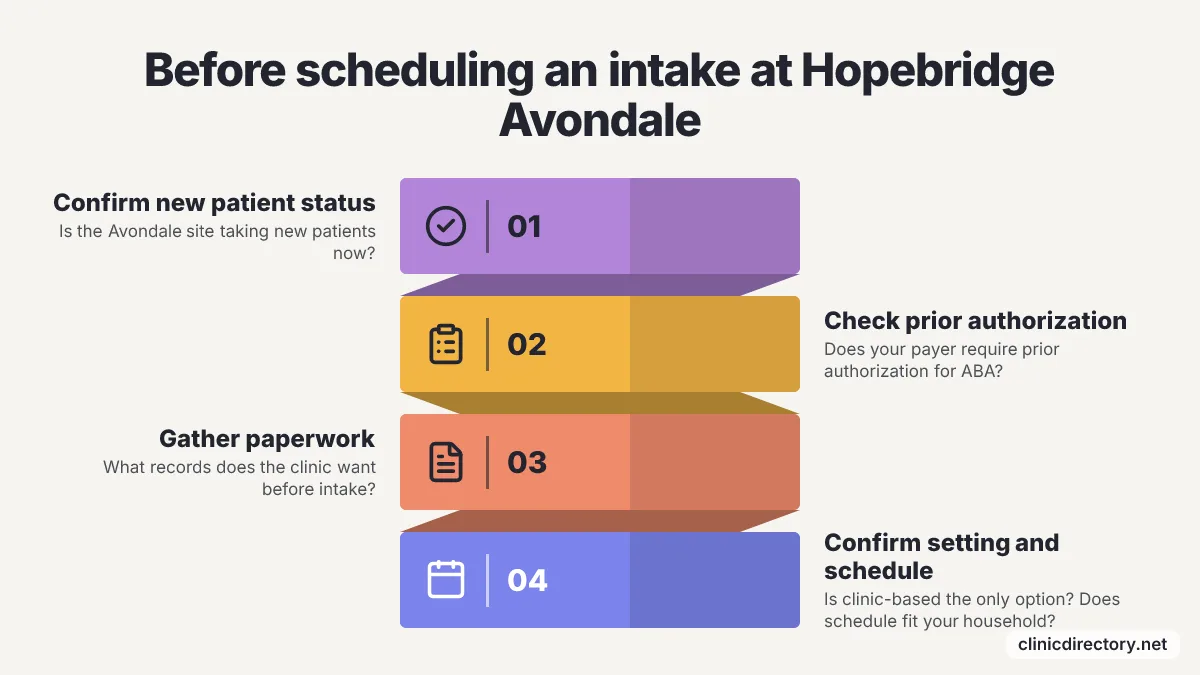
Hopebridge Avondale is a sensible next stop for a caregiver who wants concrete intake details about scheduling, travel, and plan approval. The next call should confirm whether the Avondale site is taking new patients, whether the payer asks for prior authorization for ABA, and what paperwork the clinic wants before an intake visit can be scheduled. The clinic setting gives families a real point of comparison with travel time and weekly routines, though the supplied description does not say whether other settings are offered. Ask whether the service you need is delivered at the Avondale clinic, and whether the available schedule works for your household before you gather records.
4. Behavioral ONE: family support for children
Behavioral ONE in Birmingham works with children with autism and their families in Birmingham. Behavioral ONE belongs on a shortlist when the care decision involves more than the child's therapy visit, because the provider also works with the family around autism-related needs. Behavioral ONE makes sense for a caregiver who wants to ask how family participation works before choosing a provider. The call should ask what "family" involvement means in practice, whether caregivers join planning or feedback sessions, and whether insurance coverage changes between child-focused services and any support for parents or caregivers.
The public description names children and families as the people served, but it does not list specific therapies. Ask Behavioral ONE which services it provides directly, rather than assuming the family-support wording means ABA, speech, or occupational therapy is available.
5. The HANDS Program: services for diagnosed children
The HANDS Program for autism serves children diagnosed with autism and their families in Birmingham. The HANDS Program is worth shortlisting when a child already has an autism diagnosis and the family wants a provider whose public description names both the child and the family.
The HANDS Program is not the first place to call if the family is still trying to find out whether an autism evaluation is needed, because the supplied description focuses on children diagnosed with autism. The next call should ask what diagnostic paperwork is accepted, whether the program requires a referral, and whether the current intake path differs for Medicaid, commercial insurance, and self-pay families.
That stated diagnosis requirement can help a family sort calls before sharing records. If the child does not yet have a diagnosis, ask the program whether it can explain the next step or whether the family should first contact a provider that conducts evaluations.
6. Connected ABA Collaborative: Birmingham ABA location
Connected ABA Collaborative Birmingham location lists a Birmingham location for its ABA services. Connected ABA Collaborative is a practical addition when a family is comparing aba agencies near me and wants to verify that the organization has an Alabama location tied to ABA before spending time on intake paperwork. Connected ABA Collaborative should be checked for location, service availability, and payer fit before a family treats the listing as an appointment option. The next call should ask whether the Birmingham location is taking new patients, which clinicians or teams serve that location, and whether the listed ABA services match the child's age, diagnosis status, and insurance requirements.
The supplied information confirms the Birmingham location and ABA services, but does not specify the ages served or whether sessions take place in a clinic or another setting. Those two questions can separate this option from a provider whose description already states an age group or clinic-based model.
How should Alabama families choose from this shortlist?
The first filter should not be reputation. It should be whether a provider can confirm the exact service, the payer path, and the intake rule for your child before you send records. A center can have the right name and still be the wrong choice if it does not see the child's age, does not take that plan, or has a referral rule the family never expected. The six descriptions do not justify a quality ranking, and they do not support a comparison of clinical outcomes.
Clinic Directory is a free US healthcare directory for patients and caregivers, with no account required. Clinic profiles help families narrow choices by city and state, specialty, insurance, services, language, and published capabilities, but some fields can be missing or stale because the site pulls from public clinic websites, business listings, and review-platform information. A directory profile can narrow the first calls, but it cannot confirm current intake status or whether a specific plan is accepted at a specific location. Use the profile to find the details worth checking, then ask the provider to confirm each one directly before sending clinical records.
A practical call sequence keeps the search from turning into a loop. Start with the provider that most clearly matches the child's known need, then use the same questions for every autism treatment option so the answers can be compared.
- State the child's age and whether there is already an autism diagnosis.
- Ask whether the provider is taking new patients for the specific service you need.
- Ask whether the service is ABA, speech therapy, occupational therapy, or another support.
- Ask whether a referral, diagnostic report, or prior authorization is required before intake.
- Ask whether the exact insurance plan is in network at the Birmingham location.
- Ask what self-pay information is available if the plan is out of network or authorization is denied.
- Ask whether the appointment is clinic-based, home-based, or handled another way.
- Ask what records the caregiver should send before the first intake conversation.
Alabama Medicaid rules make verification especially important for ABA searches. In June 2026, Alabama Medicaid referral pause delayed a planned deadline for a new pediatrician specialty designation tied to ABA referrals, so families using Medicaid should ask the provider and Medicaid what referral rule is current before scheduling. The practical point is to check the rule at the time of the call, not to rely on an older checklist or a provider page that may miss a policy change. Ask the clinic to describe the referral it requires, then confirm any Medicaid requirement with Alabama Medicaid before treating the referral as complete.
Provider enrollment is another Medicaid question to ask before a family commits to a center. In June 2026, Alabama Medicaid provider revalidation announced expedited revalidation for ABA providers, which makes it reasonable to ask whether a chosen ABA provider's Medicaid enrollment is current for the service and location you plan to use. Federal guidance points families toward individualized care questions rather than a one-size-fits-all ABA assumption. In August 2026, the CMS autism therapy toolkit encouraged individualized ABA care and stronger oversight without imposing new federal coverage restrictions, so the useful question is what the child's plan would include and how the provider reviews progress.
A parent can make that discussion specific by asking what goals the provider would consider for the child and how progress would be reviewed. The CMS guidance does not establish which of these Birmingham providers is the right clinical choice, so families still need to discuss the child's needs with the provider. Care availability can change quickly when a service model changes. In January 2026, a WSFA report on home-based care described disruption for some Alabama families after the Alabama Department of Mental Health communicated the end of its agreement with Key Autism Services, which is why families should ask whether the provider is offering the setting they need now.
A family looking for home-based sessions should not infer that an ABA provider offers them simply because it serves the area. Confirm the setting directly, and ask what alternatives the provider can describe if the preferred setting is not currently available.
The common aba center near me search is useful only after the family defines what near means for repeated visits. A nearby clinic that cannot take the plan, cannot serve the child's age, or requires paperwork the family does not have will not move the intake forward, while a farther Birmingham option may be more realistic if the payer path is clear.
Administrative tools behind provider billing are not the family's main decision point, but payer work affects how quickly coverage questions get answered. LunaBill is AI Revenue Cycle Automation for Hospitals & RCM Firms; for a caregiver, the practical task is still to ask the clinic and insurer for plan-specific answers before relying on a website label.
Adult psychiatric care is the named case where this shortlist should not guide the decision. A person age nineteen or older seeking medication management, depression treatment, anxiety treatment, or adult therapy needs a different behavioral health search, and an Alabama-specific clinic list such as medical clinics in Anniston is a better starting point for broader non-autism clinic calls.
A short script keeps the call focused when the clinic phone tree is busy: I am calling about autism services for my child. My child is age __ and has, or does not yet have, an autism diagnosis. Are you taking new patients for ABA, speech therapy, or occupational therapy at the Birmingham location, and what referral, insurance, and records do you need before intake? The answer should give you the next task, not just a promise that someone will call back.
If the first person who answers cannot confirm insurance or referral details, ask which office or contact can confirm them and write down the next step. Recording the provider's answer beside the same question for each center makes it easier to compare actual intake paths rather than relying on memory.
Conclusion
Start with the provider whose public description most closely matches the child's known need, then call with the same questions for every center. The work takes a diagnosis status, the child's age, the exact insurance plan name, any referral paperwork and a note of which setting the family can realistically attend.
Clinic Directory and this article stop at shortlisting. The provider and insurer must confirm current openings, network status, authorization rules, referral requirements, price and whether the service is appropriate for the child. If the first call cannot answer those items, keep the center on a maybe list and move to the next call before sending records or arranging an intake.
Frequently Asked Questions
Which autism therapy centers in Alabama offer ABA?
The article names Mitchell’s Place for ABA, speech and occupational therapy; Hopebridge Avondale for clinic-based ABA; and Connected ABA Collaborative for ABA services at its Birmingham location. The other entries do not have a specific therapy type named in the supplied descriptions. Confirm directly whether a listed service is available for your child and whether the provider is accepting new patients.
Which Alabama autism therapy center offers ABA, speech and occupational therapy?
Mitchell’s Place in Birmingham is the option whose description names all three: ABA, speech and occupational therapy. The article does not establish that a child can receive all of them there or that one intake covers each service. Ask whether each therapy has a separate evaluation or intake, and whether insurance, referral requirements and current availability differ by service.
Which Birmingham autism centers serve children or adolescents?
Glenwood Behavioral Therapy Center is described as serving children and adolescents, including those with autism. The HANDS Program serves children diagnosed with autism and their families, while Behavioral ONE works with children with autism and their families. The article does not give a complete age range for every center, so confirm the age fit directly before arranging intake.
How should I compare autism therapy centers in Alabama?
Compare whether each center offers the specific service your child needs, serves the child’s age, and has a setting and intake process that fit your family. Ask about insurance, referral requirements and current availability before sharing records. The article does not establish a quality ranking or compare clinical outcomes, so use the shortlist to guide calls rather than treating it as a ranking.
Do these Alabama autism therapy centers accept Medicaid and new patients?
The article does not confirm which centers accept Alabama Medicaid or whether any is currently taking new patients. It recommends checking each provider’s insurance network, referral requirements and availability directly. When calling, ask whether the Birmingham location is accepting new autism-related referrals for your child’s age and service, and whether Medicaid coverage or authorization affects the intake process.
Related reading
- 5 Alaska Stroke Care Centers: Hospitals and Rehab Options
- 5 Medical Clinics in Anniston, Alabama to Call First
- Best Outpatient Physical Therapy Clinics in West Virginia (2026 Shortlist)
- Best Maternal Health Therapy Clinics in Nevada, Ranked
- Infusion Centers Near Grayling, Michigan - Care Options