Summary: For the best vascular surgeons in Georgia, consider groups like Georgia Vascular Specialists in Atlanta for independent care, North Atlanta Vascular Clinic for multiple northern locations, Northside Vascular Surgery for comprehensive vein and artery care, Vascular Surgical Associates for a large group with diverse expertise, South Atlanta Vascular Institute for team-based evaluation, and Georgia Endovascular for minimally invasive procedures. Always verify insurance, location, and availability before booking.
A referral for calf cramping, leg swelling, or an incidental abdominal scan often leaves people staring at an order slip and wondering which office to call first.
Most people go straight online and search for the best vascular surgeons in Georgia, then sort by star ratings.
That misses the details that actually shape care: where the procedure happens, which hospitals the surgeon can use, what insurance network applies, and how narrow the surgeon's focus is. Vascular care covers a lot of ground, from cosmetic spider vein injections to open repair of a complex abdominal aortic aneurysm.
A surgeon with glowing reviews who spends most of the week on varicose veins won't help much with carotid stenosis. An academic team that handles major reconstructions may still book routine venous insufficiency visits months out. Better results usually come from matching the diagnosis on the referral to a clinic built for that problem.
A short list starts with the condition itself. Then check whether the group works from an ambulatory surgery suite or a hospital outpatient department, confirm the network status, and see if the office is taking new patients. Online listings can point to clinicians across the state, but a phone call still matters before you book a visit.
1. Georgia Vascular Specialists, PC: independent vascular medicine in Atlanta
Georgia Vascular Specialists, PC is an independently owned vascular medicine practice in Atlanta, which may appeal to patients who want a focused private group instead of a large hospital system. For Atlanta options, patients should ask where the first visit, duplex ultrasound, and later procedures happen, since that may be a private office or a hospital operating room tied to the group. That choice affects scheduling and billing.
This practice fits best when the referral names a clear vascular issue and the patient wants direct staff contact about records before the appointment. Picking the right specialist has less to do with broad quality claims and more to do with whether the group treats the specific condition, takes the patient's insurance tier, and has room for an intake visit with the right physician.
There is a catch with an independent group, and it sits in the outside logistics. Patients still need to check where the surgeon has hospital privileges, where advanced imaging takes place, and which operating rooms count under their insurance plan. Even a strong clinical match can lead to surprise charges if the facility is out of network.
2. North Atlanta Vascular Clinic: several north Georgia office choices
North Atlanta Vascular Clinic offers evaluation and treatment for a range of arterial and venous problems from offices in Suwanee/Johns Creek, Cumming, Alpharetta, and Lawrenceville, Georgia. That spread of suburban sites helps people who need shorter drives for repeated visits, especially when sedation or a vascular procedure limits driving afterward. It can be a practical choice when travel time and caregiver help shape the decision across the northern Atlanta metro area.
Before the first visit, patients should ask whether consultations, duplex ultrasound, and procedures all happen at the local office or whether some of them require a trip to a central site.
A multi-office practice works differently from a single-site clinic. Services, physician schedules, and equipment can change from one location to another. If you call with the referral diagnosis, insurance details, and preferred city, the scheduler can check whether that office has the right equipment and the right provider for that diagnosis before a date is set.
3. Northside Vascular Surgery: vein and artery care in one practice
Northside Vascular Surgery offers vascular surgery and endovascular treatment in one clinical setting. It handles diagnosis and treatment for complicated problems in both arteries and veins, which matters when a referral does not yet settle whether the next step is watchful care, a catheter procedure, or open surgery.
That mix helps patients who want medical treatment and surgery discussed under one roof. If a family member is calling for someone else, they should ask whether the practice handles the exact problem, which outside scans or discs need to be sent in, and whether the doctor wants an insurance referral before the visit is booked.
The regional health system also added another physician to its roster in September 2026, Northside Hospital Heart Institute welcomed a new vascular surgeon, Dr. Nathaniel Dillard, who sees patients in Lawrenceville for difficult vascular conditions such as aortic aneurysms, carotid disease, and peripheral arterial disease. People looking at clinics tied to the system should check the exact doctor, the site, and the procedure area before assuming their plan covers everything in the same way.
4. Vascular Surgical Associates: large Atlanta-area surgeon group
Vascular Surgical Associates has a team of 10 board-certified vascular surgeons with 40 years of experience, and they see patients across 7 Atlanta-area offices. For someone who wants an established surgical group with several specialists and reach across the region, that kind of setup can be appealing.
A larger practice can help when appointment timing matters or when a patient wants a surgeon with a particular subspecialty. But size alone tells you very little. Patients should still ask which surgeon will actually take over the case, where that surgeon does procedures, and whether follow-up visits happen back at the main office.
Board certification and a big staff are useful filters, though they do not tell you whether a clinic fits a specific diagnosis. Anyone sent in for an abdominal aortic aneurysm, carotid artery stenosis, peripheral arterial disease, or chronic venous ulceration should state that diagnosis right away and ask which test results the surgeon wants before the appointment.
5. South Atlanta Vascular Institute: team-based vascular evaluation
South Atlanta Vascular Institute brings together a board-certified vascular surgeon and a vascular interventional radiologist in the same facility. That setup gives patients two clinical views, which can matter when a problem might be handled with catheter-based treatment or with standard surgery. This is a good place to call when a patient wants open surgery and image-guided treatment discussed at the same time.
Ask who runs the first visit, because it may be the surgeon, the interventional radiologist, or a mid-level provider. It also helps to find out which prior imaging reports need to be sent ahead of time.
Care in one building does not erase separate billing rules. Patients need to ask whether the visit, the scans, and any later procedure are billed under one medical group or as separate professional and facility charges, since insurance plans often treat those items differently.
6. Georgia Endovascular: image-guided blood vessel care
Georgia Endovascular vascular practice uses board-certified vascular and interventional radiologists who work through the blood vessels with live X-ray guidance instead of surgical cuts. That profile makes the practice worth considering for patients who want less invasive care for circulation problems. If imaging shows a lesion that might be treated with balloon angioplasty, stenting, or embolization, those options should be reviewed early.
Callers should ask whether the condition is best seen by interventional radiology, whether an open surgical consult might still be needed elsewhere, and which prior vascular ultrasounds or CT scans must be reviewed first.
Catheter-based treatment does not fit every vascular problem. Choosing that route should rest on anatomy, not on sales talk. Patients should ask how the practice weighs medical treatment, interventional procedures, and referrals for open surgery.
Georgia vascular surgery groups compared at a glance
The six groups differ mainly in care model and where they see patients.
| Group | Where it sees patients | Care model |
|---|---|---|
| Georgia Vascular Specialists, PC | Atlanta | Independent vascular medicine practice |
| North Atlanta Vascular Clinic | Suwanee/Johns Creek, Cumming, Alpharetta, Lawrenceville | Arterial and venous care across several north Georgia offices |
| Northside Vascular Surgery | Northside system clinics; confirm the site | Vascular surgery and endovascular treatment in one practice |
| Vascular Surgical Associates | Atlanta-area offices | Large group of board-certified vascular surgeons |
| South Atlanta Vascular Institute | One shared facility | Vascular surgeon and interventional radiologist together |
| Georgia Endovascular | Confirm with the practice | Image-guided, catheter-based treatment by interventional radiologists |
How should you choose among Georgia vascular surgeons?
Choose by matching the diagnosis on your referral to a group that treats it, then confirm the insurance network, where procedures happen, and whether the office takes new patients.
A dependable shortlist contains two or three practical clinic options rather than an unfiltered catalog of search results. Clinic Directory is a free US healthcare directory for patients and caregivers, with no account required, and it helps people shortlist clinics by specialty, city and state, insurance, services, language and published capabilities such as telehealth or online booking.
Our directory lists 293 Vascular Surgery clinics across 96 cities as of October 2026, which demonstrates that patients have plenty of choices beyond the single provider returned by an algorithmic search. Public reviews can highlight communication trends but cannot substitute for clinical quality assessments.
A patient searching for a vascular specialist in Smyrna, for instance, should consider nearby Atlanta facilities only after reviewing the commute, caregiver transit requirements, and the physical location of the procedural suite. Travel burdens matter significantly when a treatment pathway calls for diagnostic duplex imaging, multiple pre-op evaluations, and post-procedural surveillance rather than a single intake visit.
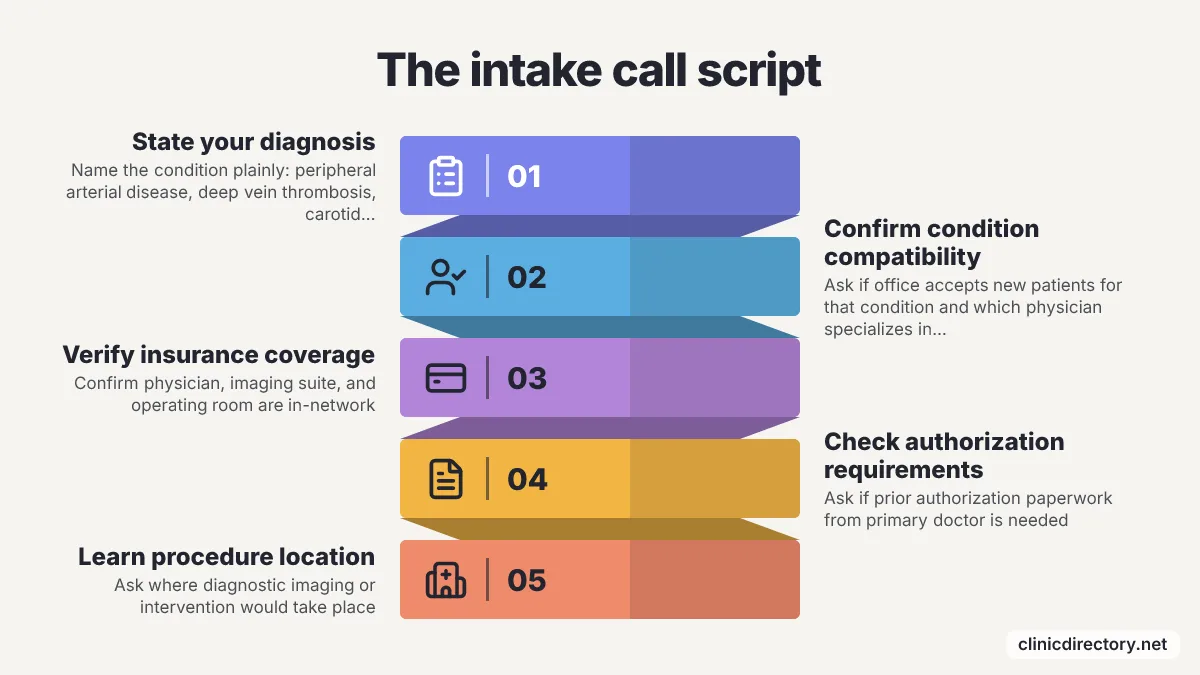
The initial phone call must confirm diagnosis compatibility. State the referral details plainly, naming conditions like peripheral arterial disease, deep vein thrombosis, carotid artery disease, or an aortic aneurysm, and ask if the office accepts new patients for that condition and which physician specializes in it.
The second inquiry must address insurance coverage and administrative referral rules. Patients must verify with both the clinic and their health insurer whether the physician, imaging suite, and operating room participate in-network, because insurance plans frequently cover physician office visits while applying out-of-network rates to the associated surgical suite.
In November 2025, the Centers for Medicare & Medicaid Services released the CY2026 Hospital Outpatient Prospective Payment System and Ambulatory Surgical Center Final Rule, effective January 1, 2026, with CY2026 outpatient payment rule projections of a 2.6% increase in total OPPS payments and a 2.4% increase in total ASC payments. While these percentage shifts do not calculate an individual patient's copayment, they underline the financial necessity of learning whether a procedure will occur in an outpatient hospital department or a freestanding ambulatory surgical center before treatment begins.
Patients can prepare a structured script to keep intake calls efficient: My physician referred me for peripheral arterial disease, and I need an appointment with a vascular surgeon taking new patients.
- Does your medical group treat this condition?
- Which provider will examine my records?
- Does your practice take my specific insurance network?
- Do you require prior authorization paperwork from my primary doctor?
- Where would any diagnostic imaging or intervention take place?
Intake procedures differ significantly between medical specialties, and patients cannot count on web forms to settle complex billing questions. An AI-powered patient intake coordinator such as Clincy is built for dental practices to automate new-patient intake, collect insurance, demographics, health history and allergies, write structured data back to the practice management system and reactivate patients who stopped scheduling, but vascular patients still need confirmation from the provider and insurer for their exact plan and service.
Traumatic vascular emergencies represent the clear boundary where outpatient shortlisting ceases to apply. In March 2026, the Society for Vascular Surgery released an updated aortic injury guideline on blunt thoracic aortic injury with 13 updated recommendations based on evidence published since 2011, establishing that acute vascular trauma requires immediate emergency transport and hospital stabilization rather than directory research.
Before finalizing any booking, confirm what medical history the surgical team requires ahead of the visit. Inquire whether the office requires raw DICOM imaging discs from prior CT angiograms or arterial duplex ultrasounds, active prescription lists, notes on nonhealing wounds, or recent discharge summaries, as a vascular consultation is only as productive as the clinical records available to the surgeon.
Next steps before booking a Georgia vascular surgeon
Identify the diagnosis written on the referral, then contact two or three Georgia vascular practices that match the appropriate regional geography, treatment approach, and insurance network. The first step is calling each practice to verify that a specialist currently accepts new cases for your specific condition and to identify where diagnostic testing and surgical interventions are performed.
Online registries, star ratings, and clinic portals can narrow initial options, but they cannot verify plan-specific benefits, authorization approvals, provider openings, or personal deductibles. Gather the medical referral, insurance card, active drug list, and recent diagnostic imaging reports before calling, and confirm your visit as soon as one provider satisfies your diagnostic needs, location limits, and insurance requirements.
When to seek emergency care instead of booking
A shortlist is for planned outpatient care only. Acute vascular trauma, such as a blunt aortic injury, needs immediate emergency transport and hospital stabilization, as the Society for Vascular Surgery guideline cited above makes clear. If vascular symptoms start suddenly or are severe, call 911 or go to the nearest emergency department rather than phoning a clinic.
Frequently Asked Questions
What should I consider when choosing a vascular surgery group in Georgia?
When choosing a vascular surgery group in Georgia, consider the specific condition you need treated, the location of the clinic, the insurance network, and whether the group has the right specialist for your diagnosis. It's also important to verify if the clinic is taking new patients and where procedures will be performed.
Why is it important to match the diagnosis with the right vascular surgery group?
Matching the diagnosis with the right vascular surgery group is crucial because different groups specialize in various areas of vascular care. A surgeon who focuses on varicose veins may not be the best choice for carotid stenosis. Ensuring the group is equipped to handle your specific condition can lead to better outcomes.
What are the benefits of choosing North Atlanta Vascular Clinic?
North Atlanta Vascular Clinic offers multiple office locations in northern Georgia, which can be convenient for patients who need shorter travel times for repeated visits. This is especially beneficial when procedures limit driving afterward. Patients should confirm where consultations and procedures will take place, as they may vary by location.
How does Georgia Endovascular differ from other vascular surgery groups?
Georgia Endovascular specializes in minimally invasive, image-guided procedures using live X-ray guidance, making it a strong option for patients seeking less invasive care. It's important for patients to understand whether their condition is best treated with interventional radiology or if an open surgical consult is needed elsewhere.
What should patients ask before visiting South Atlanta Vascular Institute?
Patients should inquire about who will conduct the first visit, whether it's the surgeon, interventional radiologist, or a mid-level provider. They should also ask which prior imaging reports need to be sent ahead of time and understand the billing structure for visits, scans, and procedures, as these may be billed separately.