
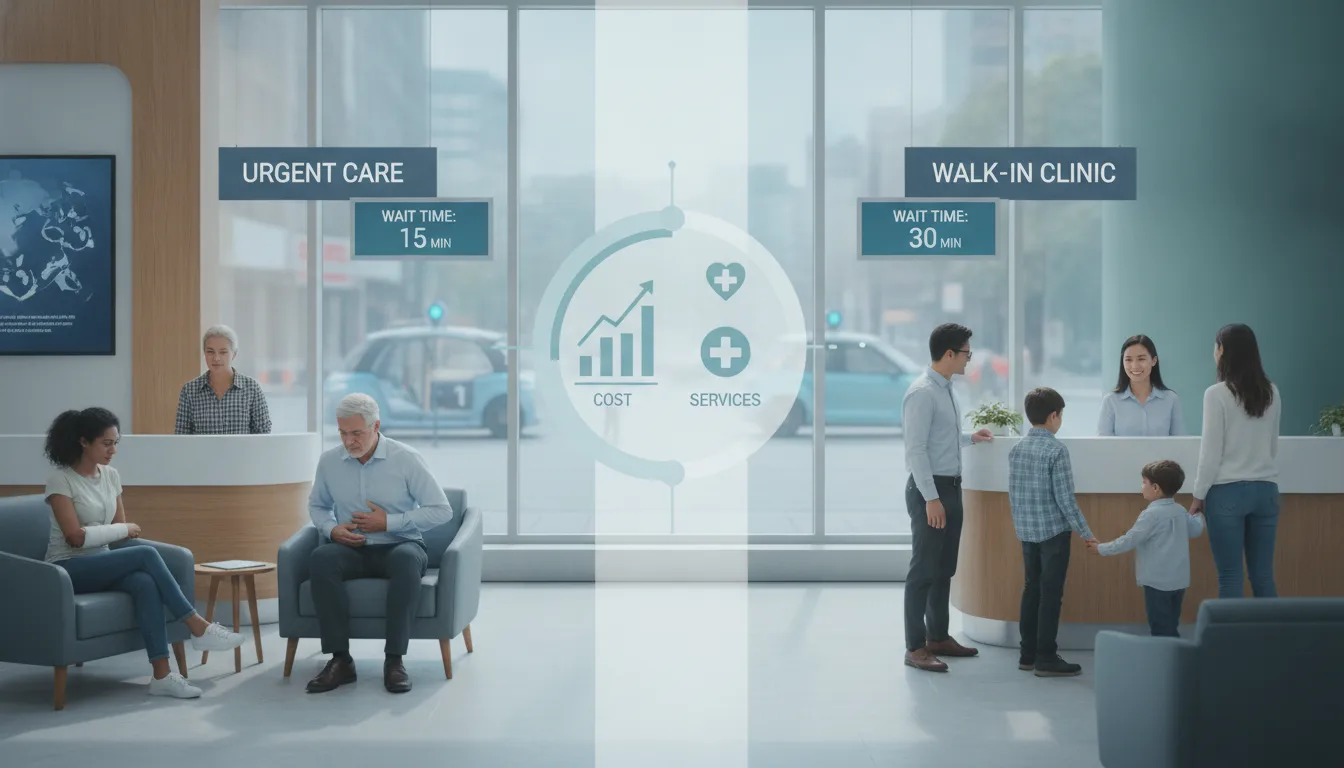
Summary: Urgent care clinics are ideal for non-life-threatening emergencies requiring immediate attention, offering extended hours and a wider range of services, often at higher costs. Walk-in clinics are more cost-effective for minor ailments, with shorter wait times and limited insurance acceptance. Choosing between them depends on the severity of your condition, budget, and insurance coverage.
A Saturday afternoon soccer spill leaves an eight-year-old limping off the grass, and the ankle balloons fast, almost absurdly, to the size of a tennis ball. The pediatrician’s office shut at noon. The ER quotes four hours. So you’re in a pharmacy parking lot with a phone in your hand, trying to sort out the urgent care vs walk in clinic mess before the kid starts crying again. Choose poorly, and a short stop becomes a long drive, an even longer wait, and a bill that makes you stare at the screen twice.
Across the country, nearly half of patients land in that same spot. They can’t tell whether an urgent care center or a retail walk-in clinic fits the problem in front of them. Of the 4,244 urgent care clinics listed across 1,263 cities in our directory, the differences are real. Some can image a fracture. Some can’t. Some charge like specialty outpatient sites. Some behave more like a standard office visit. Pick well at the start, and you save time. You also avoid paying for more clinic than you needed.
The line between them comes down to what they can actually handle. Urgent care centers sit in the middle ground. They take acute injuries, run tests, and deal with problems that need more than a quick look. Retail walk-in clinics stay narrower. They handle basic primary care and minor infections. Staffing differs. Fees do too. Hours matter as well when you need care fast and don’t want to pay for more than the visit requires.
Key Takeaways
- Urgent care clinics usually stay open late. Many also open on weekends and federal holidays, which helps when your regular doctor’s office is shut.
- Walk-in clinics usually cost less per visit, often between $50 and $100. That can suit routine illnesses and preventive shots.
- Insurance gets handled differently. Urgent care centers bill as specialized ambulatory clinics, while walk-in clinics often process visits as standard office consultations or flat self-pay.
- Their medical reach differs too. Urgent care sites may have digital X-rays and phlebotomy labs for fractures and deep cuts, while walk-in clinics stick to simpler problems like strep throat.
- Walk-in clinics often move quickly. Because they see lower-acuity patients, the time from door to exam room often stays under 30 minutes.
- Clinads gets clinics seen. Its AI-powered marketing setup helps independent and network clinics reach local patients through search placement and ad buys (Clincy, 2023).
At a Glance
| Feature | Urgent Care | Walk-In Clinic |
|---|---|---|
| Typical Wait Time | 30-60 minutes | Under 30 minutes |
| Average Cost | $100-$200 | $50-$100 |
| Insurance Acceptance | Varies widely across major commercial plans | Limited commercial coverage, frequently self-pay |
| Best For | Non-life-threatening emergencies and fractures | Minor illnesses, routine vaccines, and wellness checks |
What is Urgent Care?
Urgent care is a walk-in clinic for injuries and illnesses that need help today. It lives between a family doctor’s office and the emergency room. X-rays, lab work, stitches, and splints are all part of the package.
These centers deal with problems that can’t wait for tomorrow’s primary care opening, but they also don’t need the full trauma setup of an ER. Broken wrists. Ugly ankle sprains. Deep cuts. Asthma flare-ups. Animal bites. Something jammed in an eye or ear. The staff usually includes emergency medicine doctors or family medicine doctors, along with physician assistants and nurse practitioners.
A lot of these places keep real diagnostic equipment on site. With a radiology tech and an in-house lab, they can check for fractures, run fast viral tests, and review blood chemistry in about an hour. Patients walk out with answers during the same visit, and that can spare them an unnecessary hospital stay.
Hours are part of the draw. Urgent care clinics often stay open twelve hours a day, every day, and many keep weekend hours too. Of the 3,261 rated listings in our directory, the median rating sits at 4.2 stars out of 5, which points to solid patient satisfaction across independent and network facilities. Healthcare operators who want to keep public messaging compliant can verify their outreach standards: you can check this with our Free Clinic Ad Compliance Checker to align marketing practices with healthcare consumer regulations.
Understanding Walk-In Clinics
A walk-in clinic is a nearby spot for basic care, often inside a pharmacy or a big retail store. No appointment needed. Most are staffed by nurse practitioners or physician assistants, and they handle everyday complaints like sore throats, small rashes, sinus infections, and routine seasonal shots.
The big draw is convenience. Simple. Because these clinics sit inside places people already visit, patients can handle minor health issues while buying groceries or picking up prescriptions. Check-in is usually quick, often through a kiosk, and the visit itself tends to last ten to fifteen minutes.
Their work stays focused on low-acuity illness and basic prevention. Nurse practitioners treat pink eye, mild dermatitis, simple urinary tract infections, and seasonal allergies. They also handle blood pressure checks, cholesterol screenings, sports physicals, and adult vaccinations. That’s the lane they know best.
They don’t try to do everything. Walk-in clinics usually skip heavy equipment like X-ray rooms or large blood-testing machines. That lighter setup keeps costs down and helps them offer clear cash prices for uninsured patients. In our directory, the median rated listing carries 196 reviews, so half of those 3,261 sit below it, showing strong consumer engagement in busy retail areas.
Comparing Costs and Insurance
Walk-in clinics usually cost less. Often much less. Standard self-pay visits often land between $50 and $100. Urgent care visits tend to run from $100 to $200, and that gap matters when the problem is simple. Urgent care centers do work with wider commercial insurance networks, though the price climbs when the visit needs X-rays or a tricky wound repair, since those services bring higher copays and facility charges.
Billing rules matter more than people expect. They can keep a routine visit from turning into a nasty surprise later. Retail walk-in clinics usually code the visit like standard primary care. If you're insured, your copay often sits between $20 and $40, depending on the policy. Self-pay patients usually get a plain menu of flat prices, posted on the wall and online, so the bill doesn't arrive as a mystery.
Urgent care uses a different billing setup. It falls under specialized ambulatory facility designations. Major commercial insurers, Medicare, and Medicaid usually contract with urgent care chains, but the patient's copay is higher than the primary care rate. Many plans set urgent care copayments between $50 and $100. If the visit needs imaging, splinting, or laceration repair, those technical charges often count against the yearly deductible.
Check network status before you walk in. Out-of-network urgent care can leave you with the full facility bill plus physician fees, and that total can jump past several hundred dollars fast. In our directory, 36% of the 3,261 listings that have a rating sit at 4.5 or above. That points to a simple pattern. People who look up in-network billing first tend to report better satisfaction with outpatient care.
How to Choose the Right Option
Pick urgent care when the problem calls for imaging, deep cuts, moderate burns, or a possible fracture that needs care the same day. A walk-in clinic makes more sense for mild, familiar issues like a cold, a simple urinary tract infection, an earache, or a flu shot you need quickly.
Your symptoms should lead the choice. A child who fell hard on the playground and can't bear weight on an arm needs an X-ray, and that means urgent care or an emergency room. By contrast, an adult who wakes up on Tuesday with painful swallowing and swollen lymph nodes can step into a pharmacy clinic, get a rapid strep test, and leave with an antibiotic prescription in forty minutes.
Money matters too. Uninsured patients and people with high-deductible plans usually save a good amount by choosing a walk-in clinic when the problem fits that setting. A routine physical or rash check costs far less than the same basic care at urgent care.
Hours and wait times finish the job. If symptoms get worse after 7pm on a weeknight or show up on Sunday afternoon, urgent care is more likely to still be open and staffed. Practices that want structured patient feedback can use our Free Patient Review Request Kit to compare intake results across local review channels.
The Role of Technology in Clinic Selection
Clinic tech changes the first choice. A phone screen can show the wait, the sign-up line, and a video visit option before anyone gets in the car. Patients can book a time, see whether their insurance is accepted, and skip a packed waiting room when they don't need one.
Wait-time trackers have changed how people compare urgent care and walk-in options. Large urgent care groups and retail clinic chains post current estimates on their sites and apps, then update them every fifteen minutes as the line moves. You can join the queue at home, fill out intake forms on your phone, and arrive when the exam room is almost ready. Nice. No clipboard.
Telehealth adds another layer. Many urgent care and retail clinics run virtual services that review symptoms over encrypted video. A clinician looks at the problem remotely, decides whether in-person tests are needed, and sends ordinary prescriptions to a nearby pharmacy. If the case needs hands-on care, the virtual visit can send the chart to a local center so the in-person team doesn't start from scratch.
Patient portals also give people more to compare before they leave the house. They show billing estimates, insurance networks, and clinician credentials. They send lab results, list discharge steps, and let patients send follow-up questions to the care team. Using digital intake tools helps ambulatory practices keep their workflow steady, and patients usually feel more comfortable when the numbers and names are right there.
Conclusion
Choosing between urgent care and a walk-in clinic means weighing symptom severity, testing needs, and what you'll pay out of pocket. Walk-in clinics fit routine infections and preventive checkups. Urgent care centers handle imaging, injuries, and later hours for problems that need faster attention. Check your insurance network and look at posted wait times before you go. For fuller details on clinic profiles, service options, and insurance filters, visit How Clinic Directory works to find the right care provider near you.
Frequently Asked Questions
What conditions are treated at urgent care?
Urgent care centers see acute illnesses and injuries that need prompt attention but do not threaten life or limb. Common cases include bone fractures, sprains, deep cuts that need stitches, minor burns, asthma flare-ups, urinary tract infections, and vomiting that calls for IV fluids. Some visits are messy. That's the point.
Are walk-in clinics suitable for children?
Yes, walk-in clinics work for children older than eighteen months who have minor illnesses. They handle ear infections, pink eye, sore throats, mild rashes, and routine immunizations. For working parents, that can save time and money. Community Foot Clinic (Community Foot Clinic, 2023) notes that walk-in clinics are often a convenient choice for parents managing minor pediatric health issues.
How do I verify if a clinic accepts my insurance?
Check the clinic's official website or call the front desk before you go. Then confirm with your insurer that the specific location is in network. That tells you whether the visit uses a primary care copay or an urgent care copay.
Can I get a prescription at a walk-in clinic?
Yes, licensed providers at walk-in clinics can write short-term prescriptions for problems like strep throat, sinus infections, or skin flare-ups. Retail clinics do not stock or prescribe controlled substances. They also do not manage complex medication plans over the long haul.
What should I bring to an urgent care visit?
Bring a government-issued photo ID, your current health insurance card, and a payment method for your copay or self-pay deposit. A written list of current medications, known allergies, and relevant medical history also helps the clinician treat you safely and quickly. Don't trust memory here.
How do urgent care clinics handle follow-up care?
Urgent care centers give initial stabilization and acute treatment, then send full clinical notes to your regular primary care physician. If you need ongoing care or surgery, the urgent care provider sends a direct referral to a regional medical specialist. Henry Ford Wound Care and Hyperbaric Center - Warren Hospital (Henry Ford Health System, 2023) emphasizes the importance of coordinated follow-up care to ensure continuity and comprehensive treatment.
Recommended resource
Related reading
- Managing Patient Expectations in Delayed Appointments: A Guide for Clinics
- Leading Occupational Health Services in Midland: Location-Based Client Guide
- Dr. Keishia Mackie Reviews: Clinic Impact in 2026
- Navigating Ethical Challenges in Clinic Operations

